
The short answer
If you only read one paragraph: blinds win on precision, low maintenance, and heat control; curtains win on softness, insulation, and full blackout. Blinds suit kitchens, bathrooms, studies, and anyone who wants a clean, low-fuss look. Curtains suit bedrooms and living rooms where comfort and a softer atmosphere matter more than millimetre-precise light control. Most HDB and condo units end up mixing both across the home rather than standardising on one.
Head-to-head comparison
| Factor | Blinds | Curtains |
|---|---|---|
| Light control | Precise — tilt slats or raise/lower to the exact gap you want | Binary — open or closed, unless layered with a sheer |
| Full blackout | Only with dedicated blackout blinds (dimout ~50–70%, blackout ~90–95%) | Blackout curtains routinely hit near-total darkness |
| Privacy | Excellent, adjustable by the degree | Excellent when closed, none when open |
| Heat/UV rejection | Good, especially outdoor/ziptrack blinds mounted outside the glass | Moderate — blackout-lined curtains help, but don’t block heat at the source like an external blind |
| Maintenance | Wipe-clean, no laundering | Needs periodic washing or dry cleaning |
| Cost (per window, installed) | Generally the more affordable option for a clean, minimal look | Higher upfront for good fabric + lining, more if motorised |
| Aesthetic | Streamlined, modern, minimal | Warm, soft, hotel-like — adds texture and sound dampening |
| Best for | Kitchens, bathrooms, studies, low-maintenance living | Bedrooms, living rooms, anywhere comfort matters more than precision |
Best choice by room
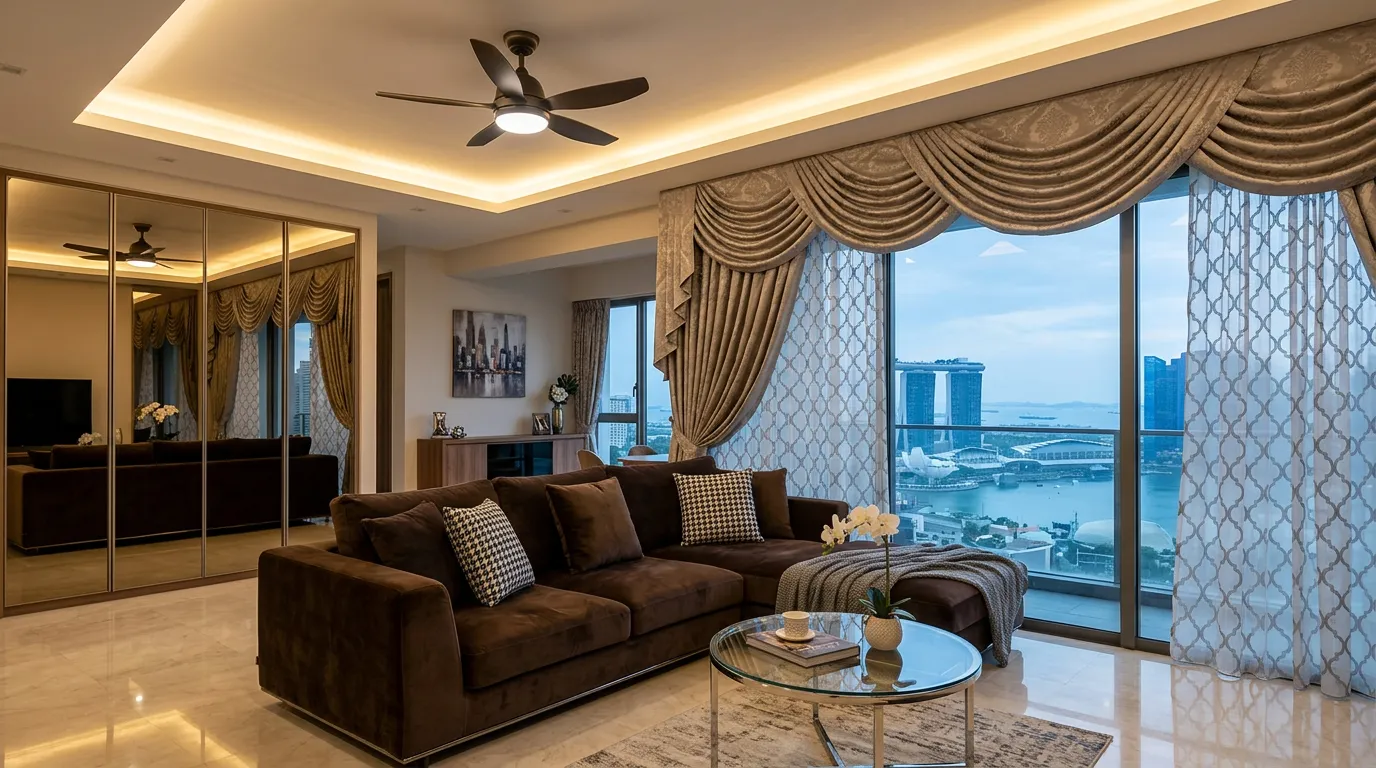
Living room. Curtains are the default here — they soften a large window wall and add warmth to what’s usually the most photographed room in the home. If your living room has floor-to-ceiling glass facing west or a busy street, pair curtains with a sheer for daytime privacy without losing all the light, or consider a day & night curtain that switches between the two without extra hardware.
Bedroom. This is where blackout matters most. Blackout curtains are the most reliable way to get a genuinely dark room for sleep — more consistent than blinds unless you go with a dedicated blackout blind. If you prefer the cleaner look of blinds, our Korean combi blinds (also called combi or zebra blinds) let you layer sheer and blackout fabric in one track, giving you both softness and full darkness on demand.
Kitchen and bathroom. Blinds win, plainly. They don’t absorb cooking odours or humidity the way fabric does, and they wipe clean in seconds. Roller blinds or venetian blinds are the practical default here.
Study or home office. Precise light control matters for screen glare — venetian blinds let you angle light in without a full close, which curtains can’t do without going fully dark.
HDB corridor-facing windows. Privacy is the priority over light or heat here. Roman blinds or a lightly opaque combi blind give you privacy control without permanently sacrificing the window.
Balcony or floor-to-ceiling glass doors. If the window is exposed to direct sun for most of the day, an outdoor/ziptrack blind mounted outside the glass blocks heat before it ever reaches the room — something no indoor curtain can do as effectively.
Can you use both?
Yes, and increasingly Singapore homeowners do. The layered approach — a functional blind close to the glass for light and heat control, with curtains in front for softness and full blackout — gives you the best of both without compromising on either. It’s more common in living rooms and bedrooms with larger windows, where a single treatment can’t comfortably do both jobs (fine daytime light control and a completely dark room at night). If budget is a factor, prioritise blinds for heat-exposed or humid rooms (kitchen, bathroom, outdoor-facing) and curtains for comfort-first rooms (bedroom, living room) rather than trying to do both everywhere.
HDB and condo considerations
Neither blinds nor curtains typically require MCST or HDB approval since they’re non-structural fittings — but outdoor/ziptrack blinds mounted on an external wall or balcony are worth checking against your condo’s house rules before installation, as some developments restrict what can be affixed to the building exterior. For BTO and new HDB flats, window treatments are usually one of the last things installed, after flooring, painting, and wallpaper are done — see our renovation guide for the full sequencing.
Our full range
Blinds:
- Roller Blinds — the everyday default, wide fabric choice, motorised options available
- Venetian Blinds — classic slat design, precise tilt control
- Korean Combi Blinds — alternating sheer/blackout stripes in one blind (also called zebra or rainbow blinds)
- Honeycomb Blinds — insulating cellular structure, good for heat and noise
- Roman Blinds — soft fabric folds, a middle ground between blinds and curtains
- Vertical Blinds — for wide sliding doors and large glass panels
- Outdoor/Ziptrack Blinds — mounted outside the glass for balconies and exposed facades
- Printed Blinds and Tripleshade Blinds — custom pattern and light-layering options
Curtains:
- Day Curtains — sheer, light-filtering
- Day & Night Curtains — dual-fabric track, switch between sheer and blackout
- Blackout Curtains — for bedrooms and full-darkness needs
- Unislat Smart Curtains — motorised, app or voice-controlled
See the full Blinds and Curtains ranges for pricing and fabric options.
Frequently Asked Questions
Are blinds or curtains cheaper in Singapore?
Blinds are generally the more affordable option per window for a clean, functional look. Curtains cost more upfront for good fabric and lining, and more again if motorised — but the gap narrows once you factor in a blackout lining, which most bedrooms need either way.
Which is better for blocking heat — blinds or curtains?
Blinds, especially outdoor/ziptrack blinds mounted outside the glass, block heat before it enters the room. Blackout-lined curtains help but work from inside the glass, so some heat has already transferred by the time it reaches the fabric.
Can I mix blinds and curtains in the same room?
Yes — it’s a common approach for larger windows. A blind close to the glass handles daily light and privacy control; curtains layered in front add softness and full blackout when needed.
Do blinds or curtains need HDB or MCST approval?
Neither typically does, since they’re non-structural. The one exception is outdoor/ziptrack blinds fixed to an external wall or balcony — check your condo’s house rules first.
What’s the best option for a HDB corridor-facing window?
Privacy is usually the priority over light control here. Roman blinds or a combi blind with some opacity give you adjustable privacy without permanently blocking the window, and can be paired with solar film if heat and glare from the corridor side are also a concern — see our heat and glare guide.