
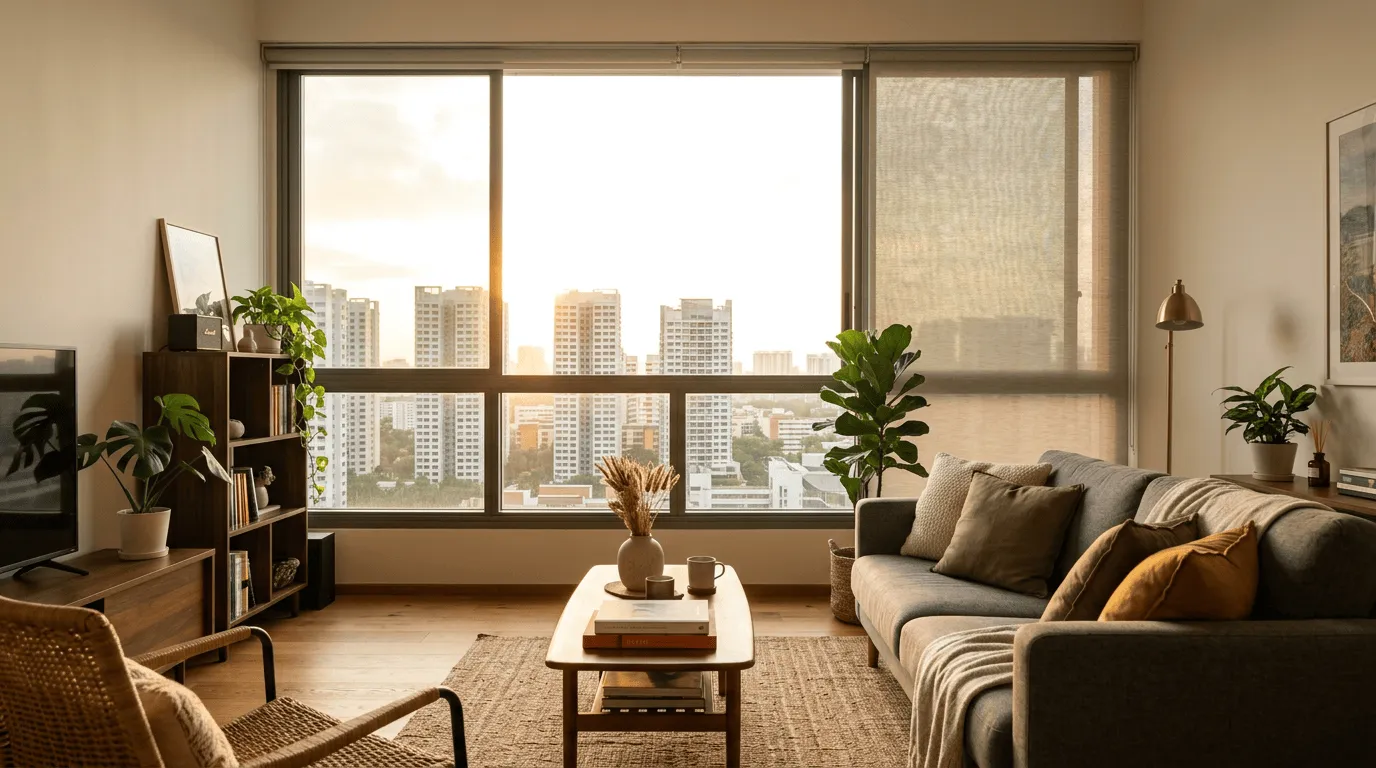
Why Singapore homes get this hot
Singapore’s near-equatorial sun angle means west and east-facing units get long, direct exposure rather than the glancing light you’d get further from the equator — a west-facing living room can see direct sun for hours in the late afternoon, right when the room is in use. HDB corridor-facing windows have a second problem layered on top: closing the curtains blocks the heat but also kills privacy from corridor foot traffic, and opening them for airflow does the reverse. Any real solution needs to address both heat and privacy, not just one.
Solar film: how it works
Solar film is a thin laminate applied directly to the glass. It works at the source — rejecting solar heat and UV before it ever enters the room — rather than blocking light after it’s already inside, which is what curtains and most blinds do. Quality films reject a high percentage of infrared heat and UV while still letting visible light through, so the room doesn’t go dark, just cooler.
What it’s good for:
- Permanent heat and UV reduction without changing how the room looks day to day
- Windows where you don’t want to block the view or lose natural light
- Reducing furniture and flooring fade from UV exposure over time
- Fixed-position glass — sliding doors, large window walls — where blinds or curtains aren’t the priority
What it doesn’t do: solar film doesn’t give you adjustable privacy or blackout. It’s a constant, passive layer — great for heat, not a substitute for a window covering you can open and close. See our full Solar Film range for film types and installation.
Outdoor blinds for heat control
An outdoor or ziptrack blind mounted outside the glass — on a balcony or exterior facade — blocks heat before it reaches the window at all, which is more effective than anything mounted indoors. If solar film works at the glass, an outdoor blind works a step earlier, stopping direct sun from hitting the glass in the first place.
What it’s good for:
- Balconies, patios, and exposed facades with heavy direct sun
- Combining heat control with adjustable shade (raise/lower as needed, unlike fixed solar film)
- Reducing air-con load in rooms with large glass exposure
What it doesn’t do: it’s an external fixture, so some condos and MCSTs have rules about what can be mounted outside — check your house rules first. See Outdoor/Ziptrack Blinds for options.
Blackout curtains for heat and glare
Blackout curtains work from inside the glass, using a dense, light-blocking lining to stop light — and with it, a meaningful amount of heat and glare — from entering the room. They’re less effective at pure heat rejection than solar film or an outdoor blind (some heat has already transferred through the glass by the time it reaches the fabric), but they’re unmatched for glare control and darkness on demand, which matters most in bedrooms.
What it’s good for:
- Bedrooms where sleep quality (darkness) matters as much as temperature
- Rooms where you want the option to fully open the window treatment when it’s not needed
- Softening a room aesthetically while still controlling light
See Blackout Curtains for fabric and lining options.
Comparison table
| Factor | Solar Film | Outdoor Blinds | Blackout Curtains |
|---|---|---|---|
| Heat rejection | High — works at the glass, constant | Highest — blocks heat before it reaches the glass | Moderate — works after heat has entered |
| Adjustable (on/off) | No — permanent | Yes — raise/lower as needed | Yes — open/close as needed |
| Privacy | Partial, depending on film type | Full when lowered | Full when closed |
| Blocks view | No — stays transparent | Yes, when lowered | Yes, when closed |
| Best room type | Any window, especially where you want the view kept | Balconies, exposed facades | Bedrooms, living rooms |
| Condo/MCST approval | Usually not required (interior-facing film) | Check house rules — external fixture | Not required |
Can you combine them?
Yes, and for genuinely hot units, this is often the right answer rather than picking one. Solar film plus curtains is a common pairing: the film handles the constant, passive heat rejection all day, while curtains give you adjustable privacy and blackout for when you actually need it — you’re not relying on the curtains alone to fight the heat. For HDB corridor-facing windows specifically, solar film with some privacy tint plus a lightweight blind (see our blinds vs curtains guide for the full type range) solves both the heat and the corridor-privacy problem without permanently blocking the window.
Best solution by scenario
- West-facing bedroom, direct afternoon sun — solar film for baseline heat control, blackout curtains for sleep.
- HDB corridor-facing window, privacy + heat — solar film with a privacy tint, paired with a light-filtering blind for adjustable coverage.
- Balcony or floor-to-ceiling glass doors, full sun exposure — outdoor/ziptrack blind, since it blocks heat before it reaches the glass at all.
- Living room with a view you don’t want to lose — solar film alone, so heat and UV drop without blocking the view or darkening the room.
- Home office with screen glare issues — solar film reduces glare on the glass itself; pair with venetian blinds for fine light-angle control during video calls (see our blinds vs curtains guide).
Frequently asked questions
Does solar film actually make a noticeable difference to room temperature?
Yes — quality solar film rejects a significant share of incoming infrared heat and UV at the glass, before it radiates into the room. The effect is most noticeable in rooms with large, direct-sun-exposed glass.
Is solar film or an outdoor blind better for heat control?
Outdoor blinds are marginally more effective since they block heat before it reaches the glass at all, but they’re an external fixture and may need MCST approval. Solar film is applied to the glass itself, needs no approval in most cases, and doesn’t block the view.
Can I use solar film and curtains together?
Yes — this is a common and effective combination. Solar film provides constant passive heat rejection, while curtains add adjustable privacy and blackout on top.
Does solar film block all natural light?
No — most solar films are designed to reduce heat and UV while still letting visible light through, so the room doesn’t go dark. This is the key difference from blinds or curtains, which do darken the room when closed.
Do HDB corridor-facing windows need a different solution than other windows?
Usually yes — corridor windows combine a privacy problem with a heat problem, since opening the window covering for airflow also removes privacy from foot traffic. A solar film with privacy tint plus an adjustable blind typically solves both without permanently blocking the window.