
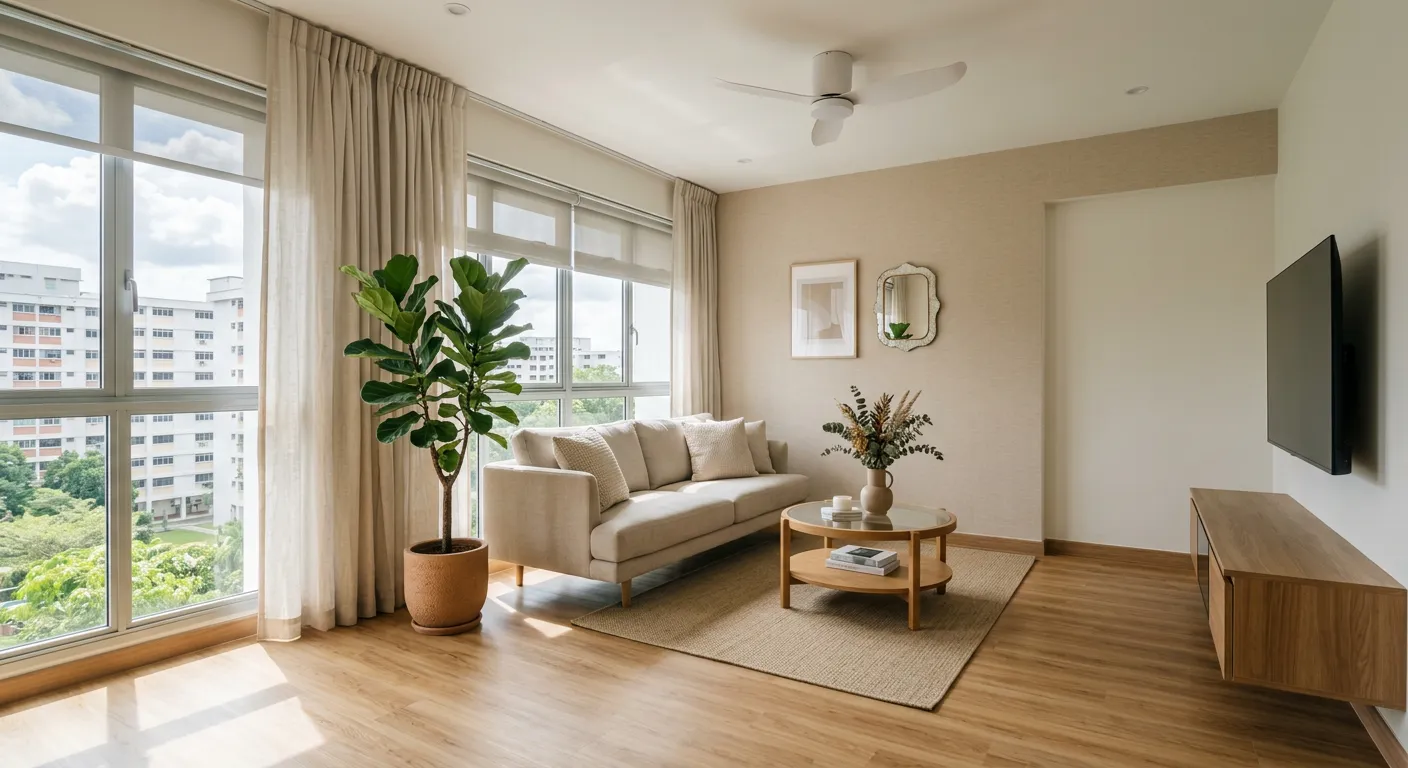
Where this fits in your renovation timeline
Get the sequencing wrong and you’ll pay for it — literally, in redone work. The general order that avoids the most common mistakes:
- Hacking and structural work (if any) — done first, always.
- Electrical and plumbing rough-in — before any wall or floor finish goes on.
- Wall preparation and painting — walls need to be primed and painted before wallpaper goes up; wallpaper over freshly painted walls needs the paint fully cured first (check your paint’s cure time, usually 2–4 weeks).
- Wallpaper — after painting is cured, before flooring goes in (protects the new floor from paste drips and installer traffic).
- Vinyl flooring — near the end, after “wet” trades (painting, wallpapering) are done, so the floor isn’t at risk of drips, spills or foot traffic damage during other work.
- Window treatments (blinds/curtains) — genuinely last. Measurements for blinds and curtains should be taken after flooring is in, since floor height and skirting affect final window and drop measurements.
If you’re working with a contractor, confirm this sequence explicitly — it’s one of the most common points where trades get scheduled out of order and something has to be redone.
Vinyl flooring: what to know before you choose
Vinyl flooring is the single highest-demand renovation search term in this category (vinyl flooring singapore, 2,912/mo) for good reason — it’s durable, water-resistant, and dramatically cheaper than natural timber while looking close to it.
The three tiers:
- Standard vinyl — thin, flexible sheet or tile, the most affordable, best for budget renovations or rental units.
- LVT (Luxury Vinyl Tile) — thicker, rigid, realistic wood/stone printing. The most popular residential choice for living rooms and bedrooms.
- SPC (Stone Plastic Composite) — rigid core, fully waterproof. Best for kitchens, bathrooms, and high-traffic areas.
For HDB flats, budget roughly by flat type — a 3-room will need less material and labour than a 5-room or executive flat, and pricing scales accordingly. See our Vinyl Flooring page for a full price breakdown by flat size, waterproof options, and our 5mm click-system installation (no glue or nails, minimal disruption).
Wallpaper vs paint: when wallpaper is worth it
Paint is cheaper and faster, full stop. Wallpaper earns its cost when you want texture, pattern, or a feature wall that paint genuinely can’t replicate — a floral or botanical print in a bedroom, a scenery mural in a living room, or a minimalist textured finish that reads as more premium than a flat colour.
Common wallpaper directions:
- Murals — large-scale scenic or artistic prints, usually one feature wall
- 3D textured wallpaper — adds depth and a tactile finish
- Floral wallpaper — popular for bedrooms and feminine-leaning spaces
- Scenery and nature wallpaper — landscape and botanical scenes, often for living rooms or home offices
- Plain minimalist wallpaper — subtle texture without a bold pattern, for buyers who want more than flat paint but nothing loud
Rule of thumb: wallpaper one or two feature walls rather than a whole room unless the pattern is genuinely subtle — it keeps cost down and avoids the room feeling busy. See the full Wallpaper range for pricing and installation.
Window treatments: the last decision, not an afterthought
Because blinds and curtains go in last, it’s tempting to treat them as a quick final step and default to whatever’s cheapest. That’s a mistake — window treatments do more work than people expect: privacy, heat control, sleep quality (via blackout), and they’re one of the most visible elements in every room.
Quick guide by space:
- Bedrooms — prioritise blackout, via blackout curtains or a Korean combi blind.
- Living rooms — curtains for warmth and softness on the main window wall; consider layering with blinds if the room gets significant direct sun.
- Kitchens and bathrooms — blinds, for easy cleaning and humidity resistance.
- West-facing or high-heat rooms — see our full heat and glare guide covering solar film, outdoor blinds, and blackout curtains together.
Full comparison: Blinds vs Curtains — The Complete Singapore Buying Guide.
Budgeting across the three categories
Whole-home condo renovations in Singapore commonly run from roughly $15,000 for a studio refresh to $150,000+ for a full high-end transformation, per current market data — but that figure covers everything: hacking, carpentry, electrical, plumbing, and finishes together. Flooring, wallpaper, and window treatments are typically a meaningful but not dominant slice of that total; the exact share depends heavily on flat size and how many rooms get wallpaper versus paint.
Practical way to budget:
- Get your vinyl flooring quote first (it’s priced by area, so it’s the most predictable number).
- Decide which walls actually get wallpaper (not every wall — see the wallpaper section above), and quote that separately.
- Quote window treatments last, once you know your final room count and window sizes post-flooring.
This staged approach also matches the renovation sequence above, so you’re quoting in the same order you’ll actually be paying.
Practical checklist
- Confirm renovation sequence with your contractor: hacking → electrical/plumbing → painting → wallpaper → flooring → window treatments
- Choose vinyl flooring tier (standard / LVT / SPC) based on room use, not just budget — SPC for wet areas is worth the premium
- Decide which walls get wallpaper vs paint — one or two feature walls is usually enough
- Confirm paint cure time before wallpaper installation is scheduled
- Hold off on final blind/curtain measurements until flooring is installed
- Prioritise blackout treatment for bedrooms specifically, not the whole home
- Check MCST/condo house rules if considering outdoor/ziptrack blinds on an external wall
Frequently Asked Questions
In what order should flooring, wallpaper, and curtains be installed?
Wallpaper after painting is cured, vinyl flooring after wallpaper (so it isn’t damaged by other trades), and blinds/curtains last, measured once the final floor is in.
Is vinyl flooring or wallpaper more expensive for a typical HDB renovation?
It depends on area covered — vinyl flooring covers the whole floor area, while wallpaper is usually limited to one or two feature walls, so total wallpaper spend is often lower even though the per-square-foot cost can be similar or higher.
Do I need MCST or HDB approval for vinyl flooring, wallpaper, or curtains?
Generally no for wallpaper and curtains, since they’re non-structural. Vinyl flooring installation is also typically permit-free, but always confirm with your MCST or town council before work begins, especially for wet-area waterproofing.
What’s the most common renovation sequencing mistake?
Measuring or installing curtains and blinds before the final flooring is down — floor height changes the drop measurement, so treatments measured too early often need re-hemming or replacement.
Should I renovate flooring, walls, and windows all at once or stagger them?
All at once if you’re doing a full renovation — it’s more efficient to sequence them together. If you’re doing a partial refresh (e.g., just refreshing window treatments), you can treat that as a standalone project without touching flooring or walls.